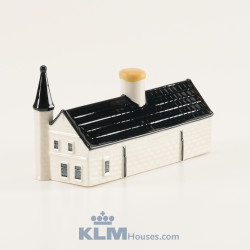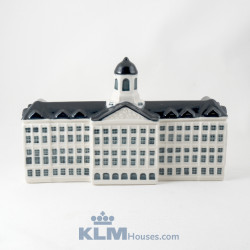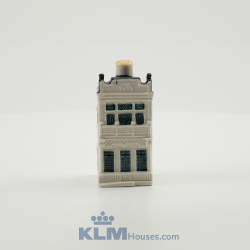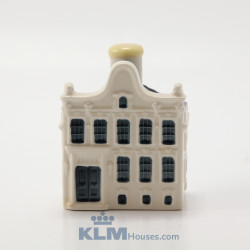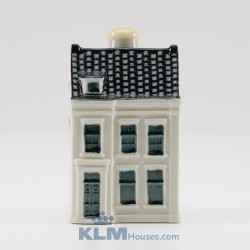


Het Scheepvaartmuseum in Amsterdam
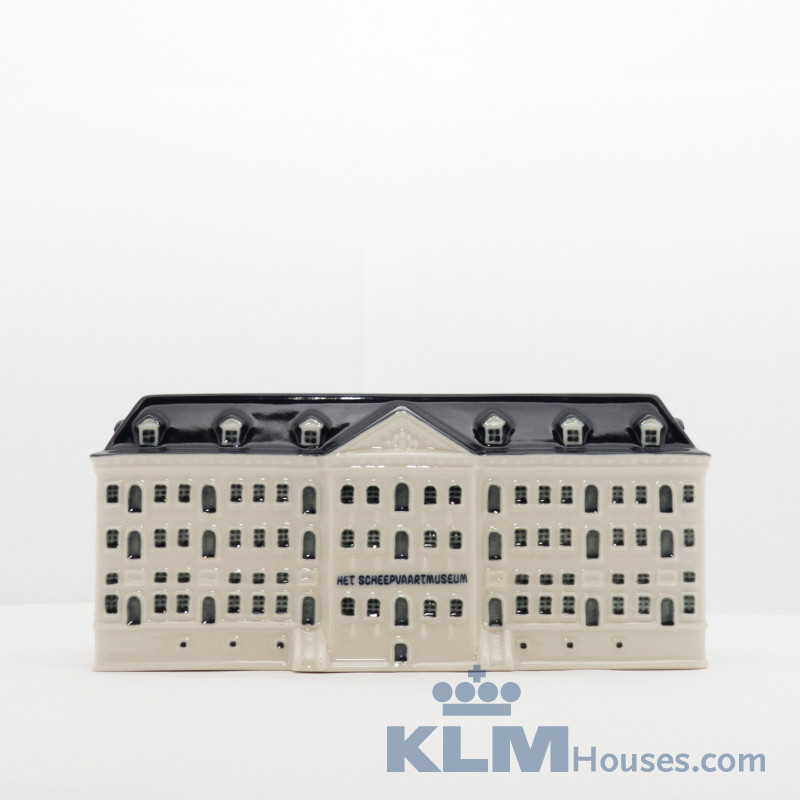
The National Maritime Museum in Amsterdam KLM’s was released on 21 januari 2016.
On Thursday, January 21, a summit on the future of European aviation took place to mark the Dutch presidency of the European Union. As the museum was the venue for a number of important meetings in 2016, KLM created a Delft Blue replica of this historic monument.
The National Maritime Museum was designed in 1656 by architect Daniël Stalpaert as a warehouse for the Amsterdam Admiralty. At the time, cannons, sails, flags and other equipment for the naval fleet were stored there. The barrel vaults beneath the courtyard could collect around 40,000 litres of rainwater, which was used to provide drinking water for the ships.
The Zeemagazijn, or Admiralty Warehouse, was built on 1,800 piles on an artificial island in Amsterdam harbour. When the building began to subside in the 18th century, buttresses had to be hastily added to prevent it from collapsing. In 1791, the Zeemagazijn was almost completely destroyed by fire, leaving only the exterior walls standing. After it was rebuilt, the blackened brick façades were covered with white plaster in a pattern designed to resemble blocks of sandstone.
In 1795, Napoleon invaded the Netherlands and the Batavian Republic was established. The five Admiralties were abolished and replaced by a national navy. The Zeemagazijn became a naval warehouse and continued to serve this purpose until the early 1970s. During a major restoration in 2007, the walls were once again covered with white plaster, just as they had been after the fire of 1791.
This is the version with “FOM” on the underside. The “FOR” version is rarer (the difference is almost impossible to see without glasses).
You might also like
Het Scheepvaartmuseum in Amsterdam