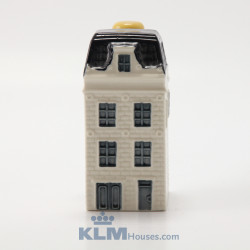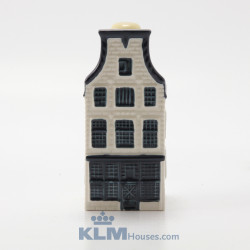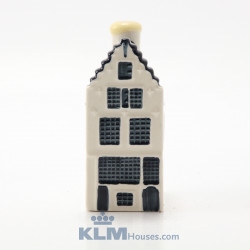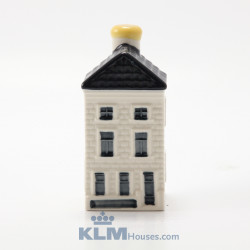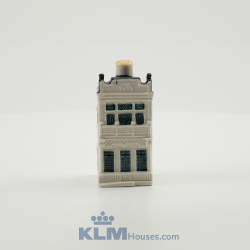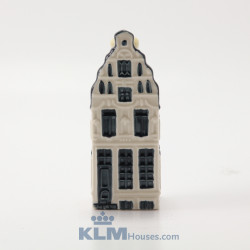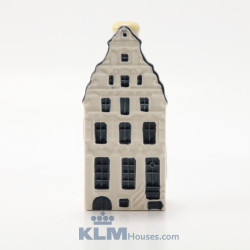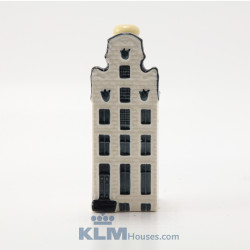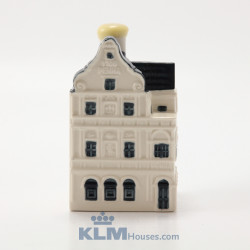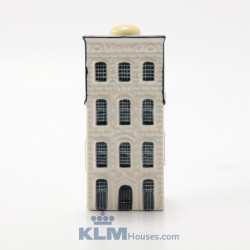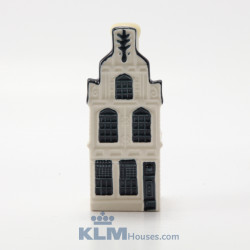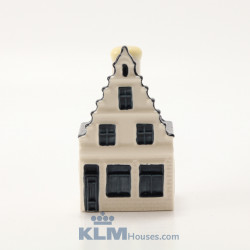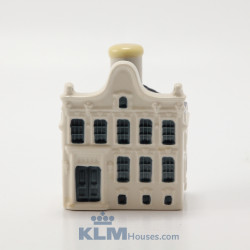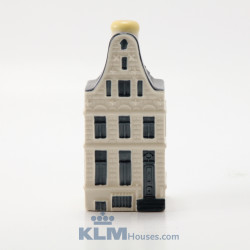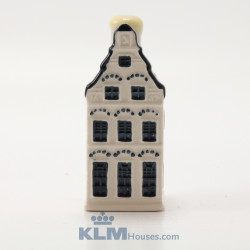


KLM House No. 8 is a miniature of Int Slodt van Egmondt at Oudezijds Voorburgwal 18 in Amsterdam. Dating from around 1615, the historic building is distinguished by its remarkable gable stone and early seventeenth-century architectural details.
KLM House No. 8 is a miniature of the historic building Int Slodt van Egmondt at Oudezijds Voorburgwal 18 in Amsterdam. The house dates from around 1615 and stands in one of the oldest parts of Amsterdam's city centre.
The name of the house refers to the former Egmond Castle at Egmond aan den Hoef. A gable stone on the building depicts the castle in its former glory. Remarkably, the castle had already been destroyed before the Amsterdam house was constructed.
The sculptor probably based the image on an older print or illustration. A similar representation of the castle can also be seen in a seventeenth-century painting.
The house was built around 1615 and originally had a stepped gable and a wooden ground-floor frontage. Its façade contains characteristic elements of the Amsterdam Renaissance, including paired pilasters, decorative arches, cartouches and sculpted masks.
The façade closely resembles that of De Gecroonde Raep at Oudezijds Voorburgwal 57, which was designed by Hendrick de Keyser. Although there is no certainty that he also designed Int Slodt van Egmondt, the influence of his architectural style is clearly visible.
Over the centuries, the original façade was altered and simplified. Around 1900, the stepped gable was replaced by a simpler gable.
During restoration work in 1939 and 1940, historic architectural details were discovered beneath layers of plaster and paint. This discovery helped preserve an important part of the early seventeenth-century façade.
Int Slodt van Egmondt
Oudezijds Voorburgwal 18
1012 GD Amsterdam
The Netherlands
KLM House No. 8 is a miniature of Int Slodt van Egmondt at Oudezijds Voorburgwal 18 in Amsterdam. Dating from around 1615, the historic building is distinguished by its remarkable gable stone and early seventeenth-century architectural details.